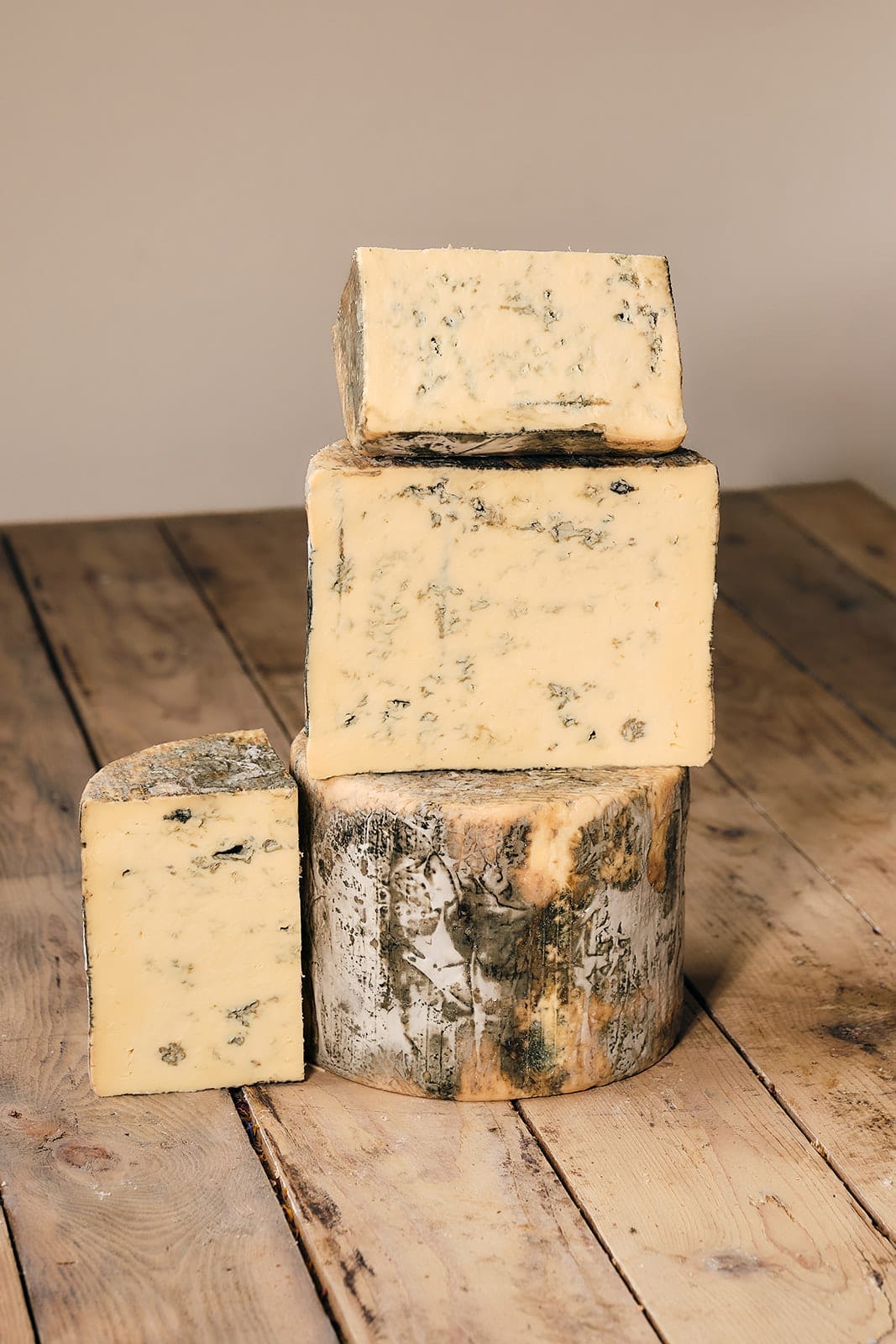
We've bought from the Grubb family since the early '90s. Iain met Louis Grubb at a Slow Food fair in Dublin and ordered a case the same week. Two decades later, their daughter Sarah and her husband Sergio run the dairy and the cellar at Beechmount — and we're still buying.
Spring is when Cashel Blue is at its best. The cows go out onto limestone-rich pasture in mid-April; by the second week of May the milk has changed completely. It's grassier, sweeter, more aromatic. Two or three weeks later that flavour starts showing up in the cheese in the cellar.
The cows are a Friesian-Jersey cross, milked once a day on limestone-rich pasture. The land does most of the work.
— Sarah Grubb, Beechmount Farm
Eight to twelve weeks in the cellar.
The wheels are hand-turned twice a week. They develop their blue veins from a controlled exposure to the cellar air — Sergio walks the room every morning, pulling samples, tasting, adjusting humidity.
At eight weeks the cheese is firm, salty, almost cheddar-fudgy in texture. By twelve weeks it's softening — spreadable at the rind, melting on the tongue. We sell both: the younger one for boards and salads, the older for the cheese course at the end of a meal.
Why we go each spring.
The cellar visit is an annual rhythm for us. It's the only way to taste what's coming in two months' time — and to flag which wheels we want set aside for our Edinburgh and London shops.
If you've bought a piece of Cashel Blue from us this spring, it almost certainly came from one of these shelves. Sergio probably turned the wheel; Sarah probably wrote the invoice.